Pearson Edexcel · GCSE · History
Course version: 1HI0 · Version from Sept 2016
C1900–present: Crime and punishment in modern Britain - 1 Nature and…
Full specification wording
Option 10: c1900–present: Crime and punishment in modern Britain - 1 Nature and changing definitions of criminal activity: Continuity and change in the nature of crimes against the person, property and authority, including new forms of theft and smuggling.
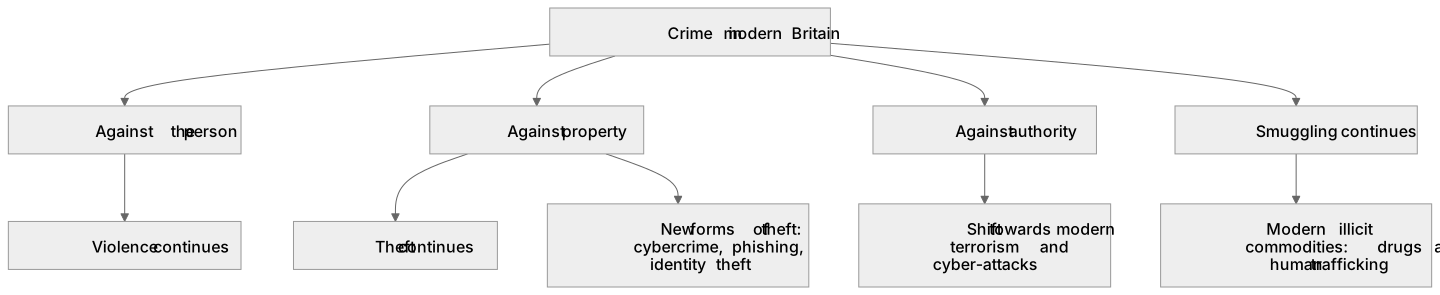
In modern Britain, categories of crime against the person, property, and authority show continuity, yet their nature has changed due to technology.
Checked against the Pearson Edexcel 1HI0 specification (opens in a new tab) on .
- Point 1 of 2
- 4 key terms
Study notes
From the checked teaching notes for this specification point.
The idea
In modern Britain, categories of crime against the person, property, and authority show continuity, yet their nature has changed due to technology. Violent crimes and theft remain prevalent, but new forms have emerged, such as cybercrime and online fraud. Smuggling continues, but instead of 18th-century contraband like tea, modern smugglers traffic illegal drugs and people, using sophisticated international networks. Crimes against authority have evolved from treason to modern terrorism, utilising the internet for radicalisation and coordination. These changes highlight how criminals adapt traditional offences to exploit modern technological advancements, fundamentally altering the landscape of criminal activity in the 20th and 21st centuries.
What earns the marks
- Identify continuities in crime, noting that theft, violence, and smuggling are still major categories of criminal activity.
- Explain how technology has created new forms of theft, such as cybercrime, phishing, and identity theft.
- Describe the evolution of smuggling from historical goods (tea, brandy) to modern illicit commodities like drugs and human trafficking.
- Analyse how crimes against authority have changed, focusing on the shift towards modern terrorism and cyber-attacks.
- Evaluate the impact of the internet and globalisation on the scale and nature of modern criminal networks.
Common mistakes and how to put them right
Claiming that traditional crimes like burglary no longer exist.
Put it right: Traditional crimes continue alongside new technological variations.
Confusing historical smuggling with modern smuggling.
Put it right: Modern smuggling involves different goods (drugs, people) and methods (commercial flights, shipping containers) compared to historical coastal smuggling.
Failing to link new crimes to the specific categories (person, property, authority).
Put it right: Categorise cyberbullying as against the person, and hacking a bank as against property.
Exam tips
- Use specific examples of modern crimes, such as 'phishing' for theft or 'people trafficking' for smuggling, to demonstrate strong subject knowledge.
- When asked about change, always acknowledge what has stayed the same (continuity) to provide a balanced answer.
- Link the emergence of new crimes directly to the technological developments of the 20th and 21st centuries.
Try the lesson
The start of the Option 10: c1900–present: Crime and punishment in modern Britain - 1 Nature and changing definitions of criminal activity: Continuity and change in the nature of crimes against the person, property and authority, including new forms of theft and smuggling. lesson, made from checked teaching notes for this specification point.
Have a go first
Which of the following is an example of a new form of theft that emerged in the late twentieth and early twenty-first centuries?
Listen
In modern Britain, categories of crime against the person, property, and authority show continuity, yet their nature has changed due to technology. Violent crimes and theft remain prevalent, but new forms have emerged, such as cybercrime and online fraud. Smuggling continues, but instead of 18th-century contraband like tea, modern smugglers traffic illegal drugs and people, using sophisticated international networks. Crimes against authority have evolved from treason to modern terrorism, utilising the internet for radicalisation and coordination. These changes highlight how criminals adapt traditional offences to exploit modern technological advancements, fundamentally altering the landscape of criminal activity in the 20th and 21st centuries. A strong answer earns marks for these points. Identify continuities in crime, noting that theft, violence, and smuggling are still major categories of criminal activity. Explain how technology has created new forms of theft, such as cybercrime, phishing, and identity theft. Describe the evolution of smuggling from historical goods (tea, brandy) to modern illicit commodities like drugs and human trafficking. Analyse how crimes against authority have changed, focusing on the shift towards modern terrorism and cyber-attacks. A common slip: Claiming that traditional crimes like burglary no longer exist. Instead, traditional crimes continue alongside new technological variations. Exam tip: Use specific examples of modern crimes, such as 'phishing' for theft or 'people trafficking' for smuggling, to demonstrate strong subject knowledge.
See it
Key words
Say what each word means before you turn the card.
Continuity and change over time
Try answering aloud or in your head before turning the card.
The impact of technology on crime
Try answering aloud or in your head before turning the card.
Globalisation and international crime
Try answering aloud or in your head before turning the card.
The changing nature of criminal activity
Try answering aloud or in your head before turning the card.
See every definition
- Continuity and change over time
- Categories of crime against the person, property and authority show continuity, yet their nature has changed due to technology.
- The impact of technology on crime
- Criminals adapt traditional offences to exploit modern technological advancements, fundamentally altering the landscape of criminal activity.
- Globalisation and international crime
- Modern smugglers traffic illegal drugs and people, using sophisticated international networks.
- The changing nature of criminal activity
- New forms have emerged, such as cybercrime and online fraud, while crimes against authority have evolved from treason to modern terrorism.
Label the diagram
Some boxes have lost their names. Pick the right name for each number.
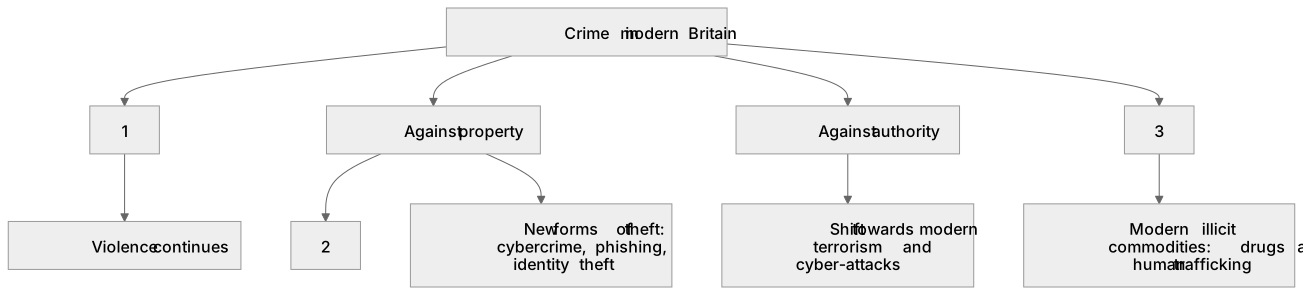
1Box 1
2Box 2
3Box 3
There is more to this lesson
The full lesson goes on to check your understanding and help you earn the marks. Create a free account to carry on, with your progress saved.
A week of Premium from your first lesson · Then the free plan continues · No card, no charge
Test your understanding of Option 10: c1900–present: Crime and punishment in modern Britain - 1 Nature and changing definitions of criminal activity: Continuity and change in the nature of crimes against the person, property and authority, including new forms of theft and smuggling.
Active recall beats re-reading. Take an instant quiz now to test what you’ve learned and lock it into long-term memory.
A week of Premium from your first lesson · Then the free plan continues · No card, no charge